

Living in North Jersey means your home goes through a lot. We get the blistering, humid summer afternoons, the endless autumn rain, and those brutal winter weeks where the temperature just bounces above and below freezing.
If your home has a stucco exterior, it probably looks fantastic; stucco has that classic, seamless curb appeal that never really goes out of style.
But here is the thing: while stucco is essentially a layer of rock on the side of your house, it isn’t completely bulletproof. It needs a little bit of strategic care to handle our local NJ climate without cracking or letting moisture inside.
Whether you just moved into a home in NJ or you’ve lived in one for years, keeping your walls in good shape doesn’t have to be a full-time job.
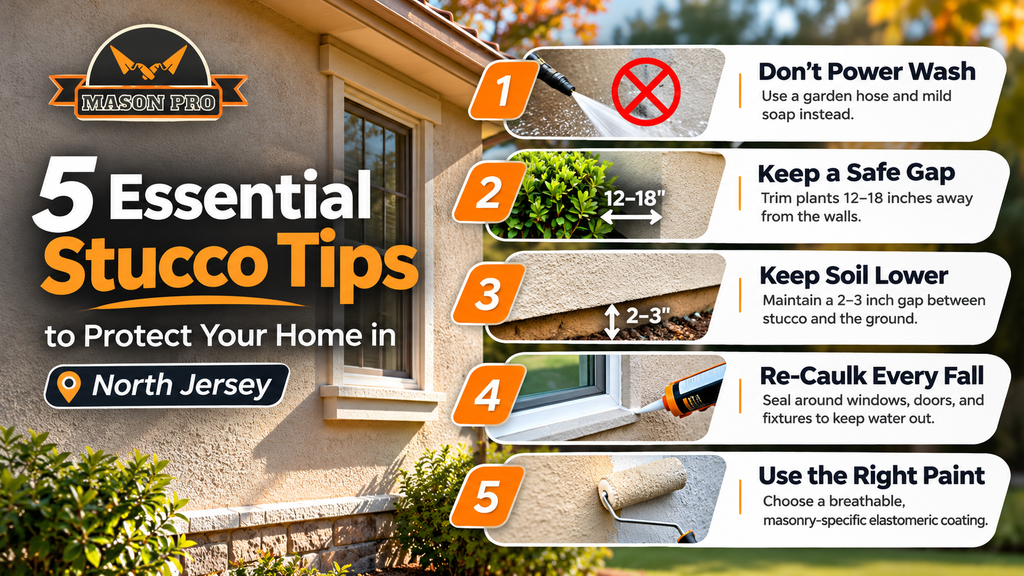
Here are a few of the most practical stucco tips to help you avoid expensive repairs down the road:
1. Put Down the Power Washer
If you take nothing else away from this post, let it be this: step away from the high-pressure power washer.
It is incredibly tempting to blast away spring dirt or green algae with 2,000 PSI of water, but pressure washers will absolutely wreck a stucco finish. They can easily gouge the surface, strip away the protective color coat, and worse, blast water straight through microscopic cracks and deep into your home’s wood framing.
The better way: Use a standard garden hose with a spray nozzle. If you have some stubborn dirt, mix up some mild dish soap and water, and gently scrub the area with a soft-bristle brush. Your walls (and your wallet) will thank you.
2. Give Your House Some Breathing Room
Your landscaping might actually be causing damage to your siding. Stucco needs air circulation to dry out after a heavy New Jersey rainstorm. If you have bushes, ivy, or tree branches resting right up against the house, that moisture gets trapped. Over time, that constant dampness leads to dark stains, algae growth, and eventual crumbling.
Grab your clippers and keep all plants trimmed at least 12 to 18 inches away from the exterior walls.
While you are out in the yard, check your sprinkler heads. One of the most overlooked stucco tips is simply adjusting your irrigation system so it doesn’t spray directly onto the house. Regular tap water hitting the wall every single morning will leave behind ugly, chalky white mineral stains (called efflorescence) and slowly wear down the finish.
3. Keep the Dirt Where It Belongs
Take a look at the very bottom of your exterior walls where the stucco meets the ground. There should be a visible gap of a few inches between the bottom edge of the stucco (the “weep screed”) and your lawn, dirt, or mulch.
If you pile mulch or garden soil all the way up against the stucco, the wall will act like a sponge, soaking up ground moisture and pulling it up into the wood framing of your house. It also creates a perfect, hidden highway for termites and ants. Always keep the soil level pulled back a few inches.
4. Grab a Caulk Gun Every Fall
Water is incredibly sneaky, and it usually finds its way behind stucco through the openings we create, specifically around windows, exterior doors, and things like outdoor light fixtures or hose bibs.
Every fall, take a quick walk around your house. If you see that the caulk around your window frames is dried out, peeling, or missing, scrape it out and replace it. You want to use a high-quality, exterior-grade polyurethane or elastomeric sealant. It only takes a few minutes and a five-dollar tube of caulk to stop a major winter leak before it happens.
5. Don’t Paint Stucco with Standard House Paint
Eventually, every stucco home starts looking a little faded and needs a refresh. But if you just run to the hardware store and buy standard exterior latex paint, you are setting yourself up for disaster.
Stucco is porous, meaning it breathes. Moisture vapor needs to be able to pass through it and escape. Standard latex paint creates a plastic-like seal over the wall. When moisture naturally gets behind the wall, it gets trapped by the paint, causing the paint to bubble and peel, and the stucco to rot and fall off in chunks. If you are going to re-coat your home, always make sure you are using breathable, masonry-specific elastomeric coatings.
Frequently Asked Questions (FAQs)
How does North Jersey’s seasonal climate impact the durability of residential stucco exterior walls?
North Jersey’s climate subjects stucco to extreme seasonal swings, ranging from humid summers to severe winter freeze-thaw cycles. Because concrete-based stucco is porous, unsealed surfaces absorb rainwater and snowmelt. When temperatures drop below freezing, trapped moisture expands, causing fine cracks to widen, loosening surface finishes, and risking structural water damage to underlying framing if not properly maintained.
Why should homeowners avoid using high-pressure power washers to clean stucco siding?
High-pressure power washing can strip away the protective color coat, gouge the cement finish, and blast water deep into microscopic cracks. Trapped water behind stucco decays wooden sheathing and structural framing. Safe cleaning involves using a standard garden hose, mild dish soap, and a soft-bristle brush to remove surface dirt and algae without damaging the wall.
How does keeping landscaping trimmed away from stucco walls prevent moisture damage?
Overgrown bushes, ivy, and tree branches trap rainwater against exterior walls and block natural airflow needed for drying. Maintaining a 12 to 18 inch gap between plants and stucco prevents dark water stains, algae growth, and premature crumbling while making routine exterior wall inspections easier.
Why is direct lawn sprinkler spray damaging to exterior stucco walls?
Continuous sprinkler spray forces water into porous stucco, leading to persistent dampness and structural decay. Additionally, tap water leaves behind stubborn white mineral deposits known as efflorescence. Adjusting irrigation heads to spray away from the foundation preserves the protective finish and prevents mineral staining.
What is a stucco weep screed and why must the ground level stay below it?
A weep screed is a metal drainage trim installed along the bottom edge of stucco walls that allows trapped moisture to drain safely out of the assembly. Piling soil, mulch, or gravel over the weep screed blocks drainage and allows ground moisture to wick upward into the home’s framing, creating a entry path for termites and ants.
What type of caulk should be used around stucco window frames and door trims before winter?
Homeowners should use high-quality, exterior-grade polyurethane or elastomeric sealants around window frames, exterior doors, light fixtures, and hose bibs. Unlike standard painter’s caulk, elastomeric sealants remain flexible during winter temperature drops, expanding and contracting with the wall to prevent water infiltration.
Why does applying standard latex house paint ruin exterior stucco walls?
Standard exterior latex paint creates an impermeable plastic-like barrier that traps moisture vapor inside the wall assembly. Trapped moisture cannot evaporate, causing the paint to bubble, peel, and flake while rot degrades the underlying cement and wood framing. Stucco requires breathable elastomeric masonry coatings or mineral paints that allow moisture vapor to escape.
What are the primary indicators that a stucco home requires professional structural repair?
Signs requiring professional repair include cracks wider than a credit card, dark water stains below window corners, bulging wall sections, crumbling edges, and hollow-sounding spots when tapped. These symptoms indicate trapped moisture behind the finish, requiring professional remediation to prevent structural framing rot.
How do local masonry contractors repair water-damaged stucco in Oakland, NJ?
Professional contractors remove damaged, delaminated stucco layers, inspect internal lath and sheathing for water rot, replace compromised wood framing, install fresh moisture barriers, and apply custom-blended scratch, brown, and finish coats. Mason Pro One LLC provides complete stucco remediation and texture matching across Oakland and North Jersey to restore wall integrity.
How does seal failure around window frames cause stucco delamination?
When window caulk dries, cracks, or shrinks, rainwater flows directly into the gap between the window frame and the stucco casing. Water accumulates behind the hard coat, rusting the wire lath and breaking the bond between the cement and the sheathing. This causes the stucco to pull away from the wall in large, bulging sections.
What is the difference between hard-coat stucco and synthetic EIFS regarding moisture management?
Hard-coat stucco uses a traditional Portland cement base applied over metal lath, creating a thick, impact-resistant shell that absorbs and releases moisture vapor naturally. Synthetic EIFS uses lightweight foam insulation boards coated with acrylic, providing higher thermal insulation but requiring strict drainage channels behind the foam to prevent water entrapment.
Why do hairline cracks form on stucco walls after severe winter freezes?
Hairline cracks develop when moisture trapped inside the cement pores freezes and expands during rapid temperature drops. Natural building movement and soil expansion during winter freezes add mechanical stress to exterior walls, causing microscopic stress fractures along corners, window edges, and material transitions.
Can professional masonry sealers prevent winter moisture absorption in stucco?
Yes, applying a high-grade, breathable silane-siloxane penetrating sealer shields stucco from moisture absorption while allowing internal vapors to escape freely. Sealing outdoor walls before winter prevents water from soaking into the cement, significantly reducing freeze-thaw cracking and salt damage.
How do property owners clean chalky white efflorescence stains off stucco walls?
Efflorescence occurs when water dissolves mineral salts inside cement and deposits them on the surface upon evaporation. Homeowners can clean mild efflorescence using a 50/50 mixture of white vinegar and water with a soft brush, followed by a gentle rinse. Persistent efflorescence requires identifying and fixing the underlying water source.
What causes green algae or dark mold growth on northern-facing stucco walls?
Northern-facing walls receive limited direct sunlight, keeping them damp longer after rainstorms and snowmelt. Trapped shade and moisture create ideal conditions for algae and mold spores to thrive. Trimming nearby shade trees, maintaining protective sealers, and washing walls regularly prevents biological growth.
How often should homeowners inspect exterior stucco for maintenance needs?
Homeowners should conduct exterior stucco inspections twice a year, ideally in spring after winter freeze-thaw cycles subside and in autumn before freezing weather returns. Checking window perimeters, ground clearances, sealant joints, and roof flashing catches minor hairline cracks before seasonal rains cause severe decay.
Why is kick-out flashing necessary where a roofline meets a stucco wall?
Kick-out flashing diverts heavy rainwater runoff from roof valleys away from exterior walls and into the gutter system. Without kick-out flashing, concentrated streams of roof water run directly down the stucco surface, soaking through wall seams and causing rapid wood framing rot behind the siding.
What steps are involved in matching a new stucco patch to an existing wall texture?
Matching stucco patches requires analyzing the original finish, such as sand float, dash, Spanish heavy trowel, or smooth trowel, and selecting aggregate sizes that match the existing surface. Technicians blend custom color pigments into the cement finish coat or apply a uniform, breathable masonry coating across the wall for a seamless repair.
How does professional stucco maintenance improve home energy efficiency in North Jersey?
Sealing exterior cracks, replacing deteriorated caulking, and applying reflective elastomeric coatings reduces unwanted air infiltration and moisture movement through exterior walls. Maintaining an airtight, weather-resistant stucco shell stabilizes indoor temperatures, lowering furnace and air conditioning demand throughout New Jersey’s winter and summer seasons.
Why should Oakland, NJ homeowners hire licensed local masonry professionals for stucco restoration?
Local masonry professionals understand North Jersey’s specific climate demands, building codes, and structural challenges. Licensed experts like Mason Pro One LLC possess the specialized tools, moisture testing equipment, and craftsmanship required to diagnose hidden leaks, execute seamless stucco patching, and protect homes for long-term durability.
When to Call in the Oakland Stucco Pros for Stucco Services
Handling minor maintenance like trimming bushes and replacing window caulk is easy weekend work. But if you notice cracks wider than a credit card, dark water stains under your windows, or areas of the wall that feel soft, hollow, or are actively flaking off, it is time to call a professional. Trapped moisture doesn’t fix itself, and ignoring it will only rot the framing underneath.
If your home’s exterior is showing its age or you suspect weather damage, our team at Mason Pro One LLC is here to help. We provide expert stucco repairs in Oakland NJ and surrounding areas of North Jersey. Other services we offer include hardscaping, patio construction, driveway and walkway building, concrete services, retaining wall construction, complete masonry services and so much more. Contact us today!